

 Log In
School sports in good shape in Chinook School Division
Posted on 14 September 2026 by Ryan Dahlman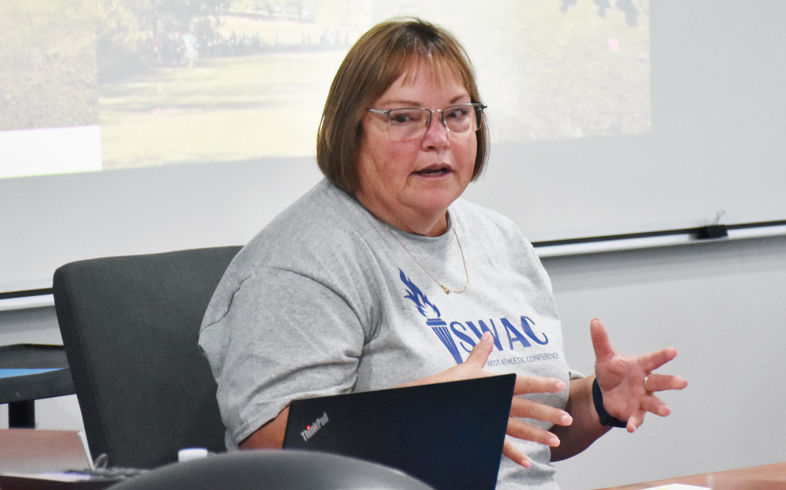
By Matthew Liebenberg
The different school sport activities in Chinook School Division were well supported by students during the 2025-26 school year.
Valerie Gordon (pictured), the athletic coordinator for the South West Athletic Conference (SWAC), felt it was a very positive year.
“We had a very good year in SWAC,” she said. “Participation in most of our sports has increased and a lot of interest in our Aboriginal coaching module that’s a requirement for our senior coaches coming up. So overall very pleased with how things are running for our schools.”
She presented the athletics status report at a regular meeting of the Chinook Board of Education on Aug. 24 and also did a media interview with this paper on Sept. 8.
SWAC coordinates and administers inter-school athletic activities in a geographical area that matches the Chinook School Division area. It falls under the umbrella of the Saskatchewan High School Athletic Association (SHSAA).
SWAC coordinates high school and junior programs, and there is a designated athletic director (a volunteer position) for each school with students in grades 7-12.
There were more than 275 teams, over 560 coaches, more than 75 adult officials and dozens of youth officials involved during the 2025-26 school year.
The sport activities on the high school level were cross country, golf, soccer, football, volleyball, basketball, curling, wrestling, badminton, and track and field. Activities offered under the junior program were cross country, volleyball, basketball, curling, badminton, track and field, and junior football in Maple Creek and Shaunavon.
Cross country continues to be a very popular sport and there was a record number of over 220 participants in 10 age categories. There were 20 junior programs and seven senior programs
As always, our cross country has grown, especially in those young grade three to seven age groups,” she said.
SWAC has therefore added a grade 3/4 category for the new 2026-27 school year to accommodate the level of interest among young runners.
Participation in golf also continues to grow. There were 48 senior golfers from nine schools. The second year of junior golf in the 2025-26 school year was also a success with 33 golfers from nine schools, which was an increase over the previous year.
“I find that our upper elementary and our middle years kids are keen to try anything and we see good participation numbers especially at those elementary and middle years,” she noted.
The Ardens and Colts teams at Swift Current Comprehensive High School (SCCHS) continue to be the only soccer programs in SWAC.
In football the SCCHS Colts is the only 12-man football team and Shaunavon is competing in nine-man football. Participation numbers in Gull Lake and Maple Creek made it difficult to compete in the nine-man program and both these schools have moved to six-man football for the 2026-27 school year.
“They’ve been fighting to get their numbers up to be able to stay at nine-man and the numbers just aren’t there,” she said. “Six-man is split into 1A and 2A based on school size. So even though Maple Creek and Gull Lake are both six-man, they will not play each other in league, because they’re in different divisions of the six-man.”
Volleyball participation continued to be strong in 2025-26. There were 24 senior teams and 27 junior teams. In the optional exhibition style senior league there were nine girls and five boys teams.
“The league has nothing to do with provincial playdowns,” she noted. “That’s why some choose not to enter league. They focus more on tournament and practice time rather than league time.”
Basketball activity continued to be influenced by the time of year it takes place. There were 15 senior teams and 27 junior teams.
“Basketball as team sports is our smallest,” she said. “Senior league is a struggle and continues to be just because of travel in the winter. That’s the reality, and having kids out on the road in winter is not an attractive option to some schools and coaches.”
SWAC tried something different for the junior girls/boys basketball playoffs, which followed a March Madness style single elimination format.
“We had more interest in that and I’m hoping to continue that this year just to raise the profile of playing off for the district league championship,” she said. “Teams got to play each other who normally didn’t. It’s a way to try to promote them to come into a league. Some schools put together a team just for this. We’re just trying to be a bit creative in promoting basketball as one of our sports.”
Participation in curling continues to be on a downward trend. Four senior and 14 junior schools competed in curling during the 2025-26 season.
“It is just a reality that our winter sports, mainly basketball and curling, are not our most popular sports,” she said. “I think it’s because kids are pulled in many directions with other winter activities. Hockey, dance and club volleyball all run at the same time and school numbers just aren’t there for us as much as they used to be.”
She added that some rural curling rinks do not open until January and by then the school curling teams are already getting into playoffs.
“We still try to promote doubles curling,” she said. “There hasn’t been a lot of uptake on that, but I’m not giving up. We think that’s a great alternative to full four-person curling.”
Wrestling continued to be based mostly in Swift Current. The SCCHS had 25 wrestlers, of whom 18 qualified for provincials. There was one wrestler at Gull Lake School who also qualified for provincials.
Participation in badminton remained consistent with teams from 15 senior and 17 junior schools.
“We realigned our sections to create some more competition pockets and that’s working well,” she said. “Our sectional playoffs are big. We then advance a few less people to the district championship, but it now allows our smaller centres to host a district championship rather than needing a place with four or five courts.”
This change was implemented as a result of feedback provided to Gordon by all the coaches.
“I took their direction to realign our playoff format,” she said. “We’ve done that actually for all our sports to create bigger sectionals, making those more meaningful and then the top one or two teams advancing out of each of the sectionals to give more opportunities to host, and then it also makes a very competitive district championship.”
All but two SWAC schools participated in track and field during the past school year and there were over 500 athletes. A previously implemented change to split competition into a senior meet for Grade 9-12 athletes and a junior meet for Grade 6-8 has proven to be a success.
“Our seniors can bring more entries just because numbers are a little smaller at the senior end and our junior numbers are huge,” she said. “It’s just awesome. The kids and the parents love it. It was a good idea.”
Female flag football on the senior level was introduced in 2025-26 as a new SHSAA activity. In the SWAC area the schools in Gull Lake and Shaunavon started programs for this sport.
“They just stayed local, because it was the first time we’ve done it,” she said. “They practiced at their school and learned the game together. Shaunavon had three teams and Gull Lake was able to field two, and they just played against each other to create interest. It was a great success with lots of excitement about it. We’re hoping that we can expand to include a couple of other schools in this.”
SWAC has initiated a review of the document that guides travel for sport during adverse weather conditions. This policy was created about five years ago and it has been working well, but Gordon realized that a few schools were interpreting things differently.
“We thought we just need to revisit this document and make sure that everyone’s on the same page with the same information,” she said.
Part of the reason for different interpretations is the availability of different sources of information through social media weather sites, and the information on some sites are updated more frequently.
“Student safety is always first and foremost,” she said. “It just needed a refresh to look at the wording and make sure we’re doing everything right.”
The SHSAA has made the Aboriginal Coaching Modules a mandatory program for all high school coaches in the province. SWAC is coordinating the scheduling of training for the different modules, which aims to create a positive coaching environment through the development of a better understanding of the uniqueness of Indigenous cultures, values, and lifestyles.
The original deadline has been changed and it is now a requirement for all grade 9-12 coaches to complete this course by Sept. 1, 2028.
“We ran six courses last year and we have another six planned for this year,” she said. “The uptake has been pretty good. We are one of the busier districts offering this course. We’re also training our own in-house facilitator, which will give us some more options to get the course out to people. Every time I sit and listen to the presenters and the people in the group sharing, you get more out of it. It’s very applicable to the world of athletics, but also classrooms. It’s needed and we hope to have all of our coaches certified by 2028.”
Leave a Reply
You must be logged in to post a comment.